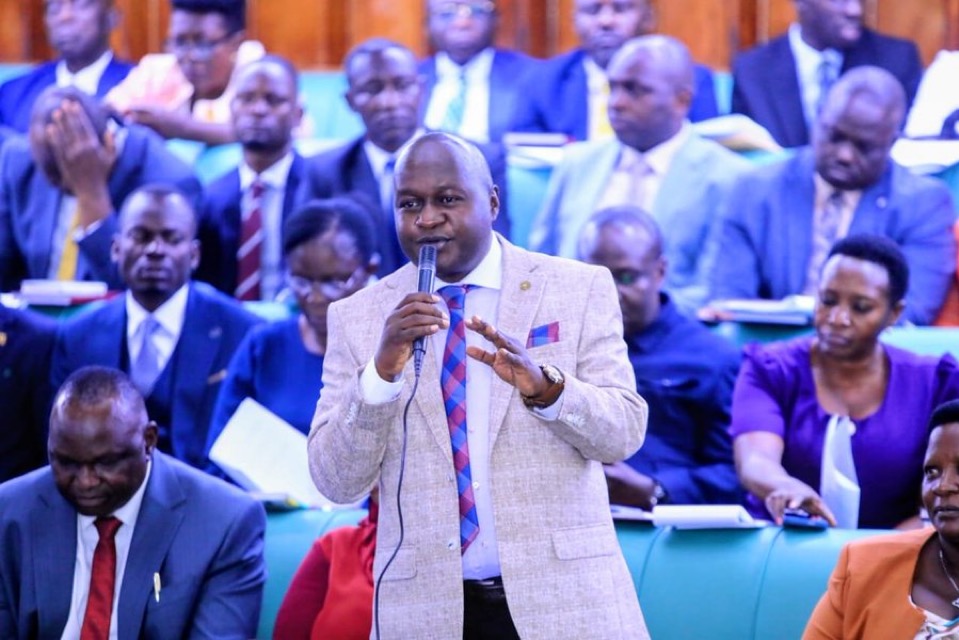
KAMPALA – The Member of Parliament for Budadiri East Constituency in Sironko District, Hon. Julius Nakiyi, has called on government to reconsider aspects of its landslide resettlement programme in the Elgon Sub-region, arguing that relocating vulnerable communities should not automatically result in the loss of their ancestral land.
Nakiyi said government must strike a balance between protecting lives, safeguarding property rights and preserving the livelihoods of communities facing the threat of landslides.
Under the current resettlement programme, government is providing UGX 18 million to each eligible household identified for relocation from high-risk landslide areas.
In Bugisu alone, approximately 13,000 households, representing an estimated population of 100,000 people, have reportedly been earmarked for the programme.
While acknowledging government’s efforts to protect communities from environmental disasters, Nakiyi raised concerns over the proposed compensation arrangement, particularly the provision of a uniform UGX 18 million regardless of differences in land sizes, residential structures and developments on individual properties.
He argued that families with substantial homes, productive agricultural land and other developments accumulated over generations should not be treated in the same way as households with considerably smaller property holdings.
The legislator called for proper individual property valuations by qualified government valuers, warning that failure to establish fair compensation procedures could expose the programme to unnecessary legal disputes.
As an alternative, Nakiyi proposed that government should continue providing the UGX 18 million resettlement support while allowing affected families to retain ownership of their ancestral land after relocating their homes and livelihoods to safer areas.
He further proposed that residential structures in designated high-risk zones should be demolished where necessary to discourage reoccupation, while the land remains under the ownership of respective families, subject to strict government regulation.
According to Nakiyi, retaining land ownership does not necessarily mean allowing unrestricted activities in environmentally sensitive areas, noting that government has the authority to regulate land use to protect human life and the environment.
He suggested that authorities could introduce a clear permitting framework to guide activities in affected areas, including environmentally sustainable practices such as tree planting, agroforestry, coffee growing and suitable fruit cultivation, depending on professional environmental assessments.
Nakiyi also proposed stricter restrictions in areas classified as extremely dangerous, including prohibiting human settlement and activities likely to destabilise the terrain.
To support his argument, the legislator cited Uganda’s wetland management system, where government regulates activities on privately or customarily held land through environmental laws and institutions such as the National Environment Management Authority (NEMA).
He argued that a similar model could be considered in landslide-prone communities across the Elgon Sub-region, as well as the Rwenzori and Kigezi regions.
The MP emphasised that land in Bugisu carries cultural, social and economic significance beyond its monetary value, describing it as a source of livelihood, heritage and identity passed down through generations.
He cited the Bugisu expression, “LWE LISWA NI BULAMU,” to illustrate the deep relationship between land and the well-being of the community.
Nakiyi warned that government interventions intended to save lives should not inadvertently expose affected families to generational poverty by depriving them of the land that has sustained their livelihoods.
He said the ultimate objective should be to protect communities from landslides while ensuring that their economic security and property rights are not unnecessarily compromised.
The legislator revealed that Bugisu leaders intend to seek space on Parliament’s Order Paper through the Office of the Speaker to introduce a motion calling for reforms in the implementation of the resettlement programme.
Among the proposed measures are continued UGX 18 million resettlement support for eligible households, retention of ancestral land ownership, establishment of a land-use regulatory framework, prohibition of settlement in extremely dangerous zones and fair compensation for any land compulsorily acquired by government.
He also called for similar consideration for other communities across Uganda facing comparable environmental challenges.
Nakiyi appealed to Members of Parliament across the political divide to support the proposed motion, describing the matter as a national concern rather than a political contest.
He maintained that Uganda needs a sustainable policy that balances environmental protection, public safety, property rights and economic livelihoods.
“Our position is clear: Government should protect people from landslides without unnecessarily depriving them of their land ownership rights,” Nakiyi said.
He clarified that the proposals were not intended to undermine government efforts but rather to improve the implementation of the resettlement programme while addressing legitimate concerns raised by affected communities.
The proposed reforms seek to ensure that communities in landslide-prone areas are able to move to safer locations without losing the ancestral heritage and economic foundation upon which their families depend.