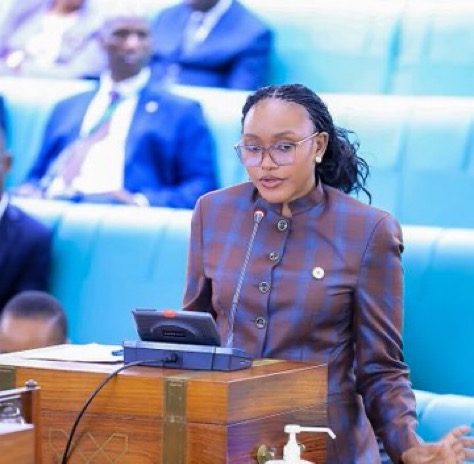
KAMPALA, UGANDA — Northern Region Youth Representative Hon. Elma Kapel Challa has called on the government to strengthen climate action programmes by ensuring that young people benefit directly from climate financing, agricultural programmes and the transition to a green economy.
Challa made the call while seconding the motion for the adoption of resolutions arising from the 8th National Youth Parliament, held on August 7, 2026, in the Parliament of Uganda.
Contributing to the resolutions on climate action, environmental protection and climate-resilient communities, she emphasised that climate change is not merely an environmental concern but a direct threat to livelihoods, food security, health, education, household income and employment.
“Climate is about livelihoods,” Challa said, noting that young farmers are among those most affected by climate-related risks but also have the potential to drive solutions.
She cited statistics indicating that approximately 62 per cent of Ugandan households engage in farming, while only 2.3 per cent of farming households have access to irrigation. She further noted that climate-related damage could cost Uganda between 2 and 4 per cent of its Gross Domestic Product annually by 2050.
Calls for climate-smart agriculture
On Resolutions 8 and 20, which address climate-smart skills for young farmers, Challa called for stronger partnerships with young people and the integration of climate-smart and regenerative farming models into the Parish Development Model and zonal agricultural research institutes.
She observed that fewer than one in ten young people aged between 18 and 30 had benefited from government agricultural programmes, while agricultural extension services reached only about five per cent of households.
Challa urged Parliament and the government to strengthen agricultural information and extension services, particularly through radio, which she said remained a major source of agricultural information for many households.
Advocates for clean cooking and forest protection
The Northern Region Youth Representative also highlighted the importance of clean cooking technologies in protecting public health, reducing household expenditure and conserving Uganda’s forests.
She noted that approximately 93 per cent of households still rely on firewood or charcoal for cooking, despite the growing availability of cleaner alternatives.
Challa called on the government to present comprehensive clean cooking alternatives to Parliament, emphasising the benefits for schools, households and the environment.
She pointed out that only 36.7 per cent of educational institutions had clean cooking technology, while schools reportedly spent between 15 and 20 per cent of their budgets on cooking fuel.
According to her, transitioning to clean cooking technologies could significantly reduce fuel costs and ease pressure on forests, whose coverage has declined from approximately 4.9 million hectares in 1990 to 2.6 million hectares in 2023.
She further called for increased investment in clean cooking technologies to help Uganda achieve its 2040 targets.
Green economy as an opportunity for youth employment
Challa identified waste management, recycling, composting and renewable energy as sectors with significant potential to create employment for young people.
She noted that approximately 80 per cent of Kampala’s waste is organic, presenting an opportunity for composting and recycling initiatives.
She also cited a programme supported by the European Union and GIZ, which trained more than 480 people in solar technology, with approximately 84 per cent reportedly securing employment after the training.
She urged the government to invest in practical green skills training and expand opportunities for young people to participate in emerging climate-related industries.
Demands youth-focused climate financing
On Resolution 18, Challa called for climate financing to be deliberately allocated to youth-led initiatives and community-based climate action.
She cited figures indicating that Uganda had mobilised approximately US$35.8 billion in climate finance across 1,620 projects, but argued that young people and local communities were not receiving sufficient direct benefits.
She proposed that the Ministry of Finance introduce an age marker within climate budget tagging to track how climate financing benefits young people.
She also called for youth and community groups to be included in benefit-sharing arrangements under carbon markets and other climate financing mechanisms.
Highlights climate vulnerability in Karamoja
Drawing attention to her region, Challa noted that Karamoja faces some of the highest levels of severe food insecurity in Uganda, citing a figure of 62.9 per cent.
She urged the government to prioritise climate adaptation projects in districts most exposed to drought, floods and other climate-related disasters.
She further called for the establishment of a dedicated youth window within climate funds and annual reporting to Parliament on the implementation of Uganda’s climate commitments.
In her concluding remarks, Challa emphasised that the resolutions arising from the 8th National Youth Parliament were not intended to create new policies from scratch, but to ensure that existing policies, programmes and financing mechanisms deliver tangible results for young people.
“These resolutions do not ask government to start again. They ask that the policies, programmes and finance we already have reach young people and that we measure whether Uganda’s young people are benefiting,” she said.
She concluded by reaffirming the readiness of young people to contribute to Uganda’s green economy through agriculture, clean cooking, recycling and other sustainable initiatives.
Challa then formally seconded the motion for the adoption of the resolutions.